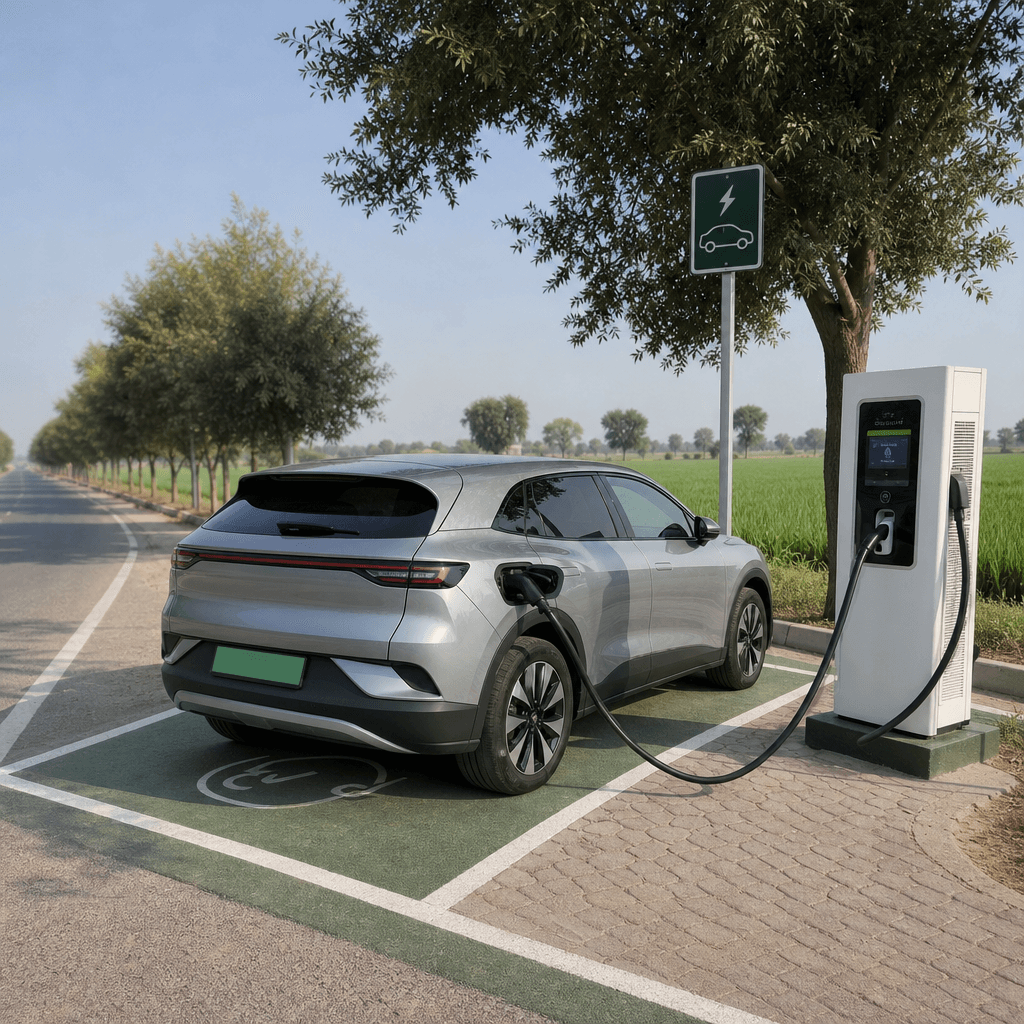
Thinking about switching to an electric vehicle? Here's what you should know about EVs, their running costs, charging, battery life and everyday use on Punjab's roads.
Imagine travelling from home to work every day without stopping at a petrol pump. Instead, you charge your vehicle at home and start your morning with enough battery for your regular journey.
For some people in Punjab, that's already part of everyday life.
Electric scooters are becoming an option for daily commuters, electric cars are attracting family buyers, and electric three-wheelers and commercial vehicles offer businesses a different way to manage transport expenses.
But electric vehicles also raise some practical questions.
Are they actually cheaper? What happens when the battery gets old? Can you take an electric car on a long highway journey? And what if you don't have somewhere to charge at home?
Before buying an EV, or even if you already own one, it's worth understanding how electric mobility works in real life.
First, What Makes an Electric Vehicle Different?
The biggest difference between a fully electric vehicle and a conventional petrol or diesel vehicle is how it gets its power.
A petrol or diesel vehicle burns fuel inside an engine. A battery-electric vehicle stores electricity in a rechargeable battery and uses an electric motor to turn its wheels.
When you press the accelerator, the battery supplies energy to the motor. The motor converts that electrical energy into movement.
That's the basic idea.
An EV still needs tyres, brakes, suspension and regular maintenance. But it doesn't require many of the engine-related components found in traditional vehicles.
Electric vehicles aren't limited to cars, either.
An electric scooter might be useful for commuting or visiting a nearby market. An electric motorcycle offers another choice for two-wheeler riders. Electric cars serve family and personal travel, while electric three-wheelers, vans and buses can be used for passenger transport and commercial work.
Not all EVs are the same, and that's important. Their prices, batteries, range, charging needs and performance can be very different.
The First Big Question: Does an EV Really Save Money?
For many people, this is where the interest begins.
When petrol or diesel prices affect your monthly budget, the idea of travelling using electricity becomes attractive.
But instead of looking only at the price of electricity, consider how much it costs to travel one kilometre.
Let's Take an Electric Scooter
Suppose you own an electric scooter with a 3 kWh battery that delivers around 75 kilometres of real-world range on a full charge.
According to Punjab's electricity tariff for 2026–27, the domestic energy rate for consumption above 300 units is ₹7.05 per unit for households with a sanctioned load of up to 20 kW.
Using this rate and allowing approximately 10% extra electricity for charging losses:
- Full charging cost: Around ₹23.
- Cost per kilometre: Approximately 31 paise.
- Daily travel: 20 kilometres.
- Monthly travel: 600 kilometres.
- Estimated monthly electricity cost: Around ₹186.
Now imagine covering the same 600 kilometres on a petrol scooter. Your fuel expense would depend on its mileage and the prevailing petrol price.
For someone who travels regularly, an electric scooter could offer meaningful savings on daily energy expenses.
However, Punjab provides up to 300 units of free electricity per month for eligible domestic consumers. Your actual charging expense depends on total household consumption, subsidy eligibility and applicable billing rules.
If additional EV charging pushes a general domestic household beyond the free-electricity limit, the resulting increase in its bill could be significantly higher than the scooter's standalone charging cost.
And What About Electric Cars?
Consider an electric car with a 30 kWh battery that delivers approximately 200 kilometres of real-world range on a full charge.
Using the same ₹7.05-per-unit electricity rate and allowing for approximately 10% additional electricity consumption during charging:
- Full charging cost: Around ₹233.
- Cost per kilometre: Approximately ₹1.16.
- Distance covered: 200 kilometres.
This means an electric car could cover 200 kilometres using approximately ₹233 worth of electricity under these assumptions.
However, actual expenses depend on the vehicle's efficiency, charging losses, driving conditions and applicable electricity tariff.
Public charging stations may charge different rates, and their customer prices can be higher than home electricity costs.
The important point: Electric vehicles can offer lower daily energy expenses, but electricity is only one part of ownership.
Purchase price, insurance, maintenance, financing, battery warranty, repairs and resale value all contribute to the total cost of owning an EV.
A vehicle that costs less to charge is not necessarily the cheapest vehicle to own.
Charging an EV: Easier Than You Think, But Not Always
One of the biggest changes when moving from petrol or diesel to electricity is how you plan to refuel—or, more accurately, recharge.
With a conventional vehicle, you usually visit a fuel station when needed.
With an EV, charging may happen at home, at work or at a public charging station.
For someone who has dedicated parking and a suitable electrical connection, home charging can be convenient.
For example, an electric scooter owner may simply connect a manufacturer-approved charger after returning home and have sufficient battery for the next day's travel.
Electric cars can also be charged at home using suitable charging equipment.
But there is another side to the story.
What if you live in an apartment? What if your parking area has no electricity connection? What if you regularly travel outside your city?
That's where public charging becomes more important.
Punjab has EV charging facilities across different cities and highways, but the availability, connector type and charging speed vary from one location to another.
A charging station shown online may not always be operational when you arrive.
Before travelling, check whether the charger is working, compatible with your vehicle and available for public use.
You can explore listed locations through EVPunjab's Punjab Charging Station Directory.
And remember, charging safely matters just as much as charging conveniently. Avoid damaged sockets, loose connections and unsuitable extension boards. Follow the vehicle manufacturer's charging instructions.
Can You Travel Between Punjab's Cities in an EV?
Suppose you live in Ludhiana and regularly visit Amritsar. Or perhaps you need to travel from Patiala to Chandigarh for work.
Would an electric vehicle make those journeys difficult?
Not necessarily.
The answer depends on the vehicle's actual driving range, your route and access to suitable charging facilities.
Some electric cars can comfortably handle many intercity journeys without needing a charging stop. Others may require charging along the way.
Electric two-wheelers have different capabilities, so the same assumptions shouldn't be applied to scooters, motorcycles and cars.
One thing worth understanding is that the range shown in an EV advertisement is not a promise of how far you'll travel every time.
Driving at higher speeds, using air conditioning, carrying additional passengers and travelling in extreme weather can all affect electricity consumption.
For a longer journey, check your route distance, expected range and charging options before leaving.
It's also sensible to keep some battery charge in reserve rather than planning to arrive with almost nothing left.
The freedom to travel isn't only about having a large battery. It's about having a vehicle that suits your journeys and knowing where you can recharge when necessary.
Punjab's Summers, Winters and Rain: Do They Affect EVs?
Punjab's weather is another important consideration.
During summer, temperatures can rise significantly. In winter, cold mornings and foggy conditions bring different challenges.
Just as weather affects conventional vehicles, it can also influence electric vehicles.
In Hot Weather
High temperatures can affect battery performance and long-term battery health.
Some EVs use thermal management systems to control battery temperature, but those systems may consume additional energy.
Using air conditioning in an electric car also draws electricity from the battery.
That means the driving range may change depending on the weather and how the vehicle is used.
During Winter
Colder temperatures can temporarily reduce battery performance and available driving range.
In some electric cars, cabin heating increases energy use.
A vehicle that gives a certain range in mild weather may deliver a different result during a cold winter morning.
During Heavy Rain
Electric vehicles have electrical protection systems, but that doesn't mean they're safe to drive through every flooded road.
Avoid deep waterlogging, follow the manufacturer's water-wading guidance and never attempt to operate or charge a vehicle that may have suffered flood-related battery damage without professional assessment.
The practical lesson is simple: EVs can operate in Punjab's changing weather, but drivers should understand their vehicle's limitations and follow the manufacturer's recommendations.
What Happens When an EV Battery Gets Old?
This is one of the most common concerns among potential EV buyers.
Many people wonder whether they'll need to replace the entire battery after a few years.
EV batteries do gradually lose some capacity as they age. This is called battery degradation.
However, a reduction in capacity doesn't automatically mean a battery has failed or needs replacing.
How quickly a battery ages depends on several factors, including its chemistry, temperature exposure, charging patterns and usage.
For example, an older battery may still operate normally but provide less driving range than it did when new.
Many manufacturers offer separate battery warranties, but the duration, distance limits, conditions and minimum capacity guarantees vary.
Before purchasing an EV, find out what the warranty actually covers.
Also check whether the battery can be repaired, whether replacement options are available and where authorised servicing is provided.
A long warranty sounds reassuring, but understanding its conditions is more useful than simply looking at the number of years.
Is EV Maintenance Really Cheaper?
Electric vehicles generally have fewer engine-related maintenance requirements than petrol and diesel vehicles.
There are no conventional engine-oil changes in a fully electric vehicle, and several mechanical components associated with combustion engines are absent.
That can reduce some servicing expenses.
But electric vehicles are not maintenance-free.
Tyres still wear out. Brakes and suspension still require attention. Electrical systems, software and cooling components may also need inspection or repair.
For a delivery rider or commercial operator, even a small breakdown can mean lost working time.
That's why local service support matters.
Before buying, check whether the brand has an authorised service centre near you, how warranty repairs are handled and whether spare parts are readily available.
An EV might look attractive in a showroom, but the ownership experience depends heavily on what happens after the purchase.
You can explore available dealerships through EVPunjab's Dealer Directory.
Does Punjab Offer Any Benefits for EV Buyers?
Government policies can influence the final purchase cost of electric vehicles.
Punjab's Electric Vehicle Policy 2022 was notified in February 2023 and was extended in February 2026, keeping it valid until 20 February 2027.
The state also extended the motor vehicle tax exemption for registered battery-operated electric vehicles for a further year.
At the national level, the PM E-DRIVE programme provides support for specified electric vehicle categories, subject to eligibility conditions and applicable scheme timelines.
However, not every EV qualifies for every incentive.
Before buying, ask the dealer for the complete on-road price, including a clear explanation of applicable tax exemptions and any available purchase incentive.
Don't assume that a subsidy mentioned in an old advertisement is still available.
The applicable benefit should be verified at the time of purchase.
Electric Scooters, Cars or Commercial EVs: Which Makes Sense for You?
The answer is different for every driver.
Consider three everyday situations.
Someone travelling 15 kilometres to work: An electric scooter with sufficient range, safe home charging and accessible service support could be a practical option.
A family that regularly travels between cities: An electric car may work well, but real-world highway range, charging compatibility and passenger requirements should be considered carefully.
A business making repeated local deliveries: An electric commercial vehicle could help reduce energy expenses, provided its payload capacity, charging time and operating range match the work.
These examples show why there isn't one perfect EV for everyone.
A bigger battery doesn't automatically make a vehicle better. Neither does a higher claimed range or a lower starting price.
The important question is how the vehicle fits your everyday requirements.
Five Questions Worth Asking Before Buying an EV
Before finalising a purchase, take a few minutes to answer these questions:
1. How far do I actually travel?
Look at your normal daily journey and your occasional longer trips. Don't select a vehicle based only on a claimed range figure.
2. Where will I charge it?
Make sure charging is practical, safe and reasonably convenient before purchasing.
3. How much will I spend over five years?
Compare purchase price, electricity, maintenance, insurance, financing and potential resale value with your alternatives.
4. Who will repair my EV if something goes wrong?
Check the authorised service network, battery warranty and availability of spare parts.
5. Does this vehicle suit my real needs?
Think about comfort, passengers, luggage, road conditions and how often you'll use it.
These questions can save more frustration than choosing a vehicle simply because it looks impressive or advertises a long range.
Are EVs Really Better for the Environment?
Fully electric vehicles don't produce exhaust emissions while driving.
That can help reduce pollution released directly onto roads, particularly in busy urban areas.
However, electric vehicles still have an environmental impact.
Battery manufacturing requires energy and raw materials, and the electricity used for charging may come from different sources, including fossil fuels.
A complete environmental comparison must consider vehicle manufacturing, electricity generation, driving and eventual battery recycling.
Even with these factors, EVs can provide environmental benefits over comparable petrol and diesel vehicles, depending on how they are produced, powered and used.
For Punjab, where transport is part of everyday life across cities, towns and villages, cleaner mobility is an important long-term opportunity.
But environmental benefits should be considered alongside affordability and practicality.
So, Is Punjab Ready for Electric Vehicles?
Electric mobility in Punjab is developing, but experiences will differ from one driver to another.
Someone with reliable home charging and predictable daily travel may find EV ownership straightforward.
Someone who depends entirely on public chargers or regularly travels through areas with limited charging and servicing facilities may have more challenges.
The future of EVs in Punjab will depend not only on new vehicle launches, but also on reliable charging, affordable repairs, accurate product information and support for owners after purchase.
And electric mobility isn't just about private cars. Scooters, motorcycles, passenger three-wheelers, delivery vehicles, buses and other commercial EVs all have a role to play.
As these options develop, drivers need information that goes beyond advertisements and impressive specifications.
They need to know what actually works.
Final Thoughts: Should You Make the Switch?
Electric vehicles offer a different way to travel, and for many people, they can be a practical one.
They may reduce daily energy expenses, offer a quieter driving experience and require less routine engine-related maintenance.
But they also bring new things to consider, including charging access, battery condition, service availability and real-world range.
If you're thinking about buying an EV in Punjab, don't begin by asking which one has the biggest battery or the highest claimed range.
Start with a simpler question:
Will this vehicle make my everyday travel easier and more affordable?
If the answer is yes, and the costs and charging arrangements work for you, an EV may be worth considering.
At EVPunjab.com, you can explore electric scooters, motorcycles, cars and commercial EVs, compare their specifications, find charging stations and discover information designed to help you make informed decisions.
Because choosing an electric vehicle shouldn't be about following a trend.
It should be about finding a better way to travel—one that works for you.